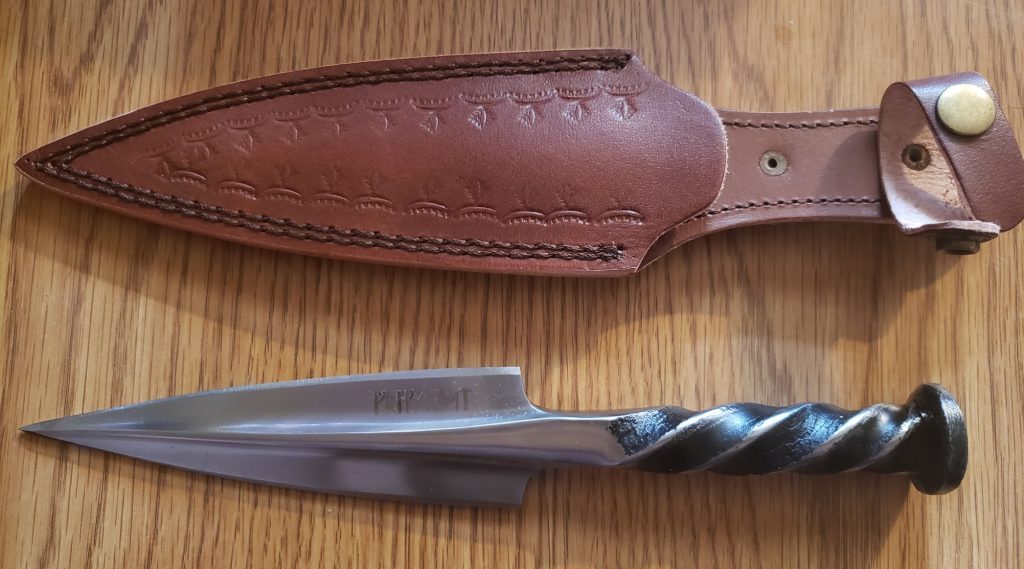
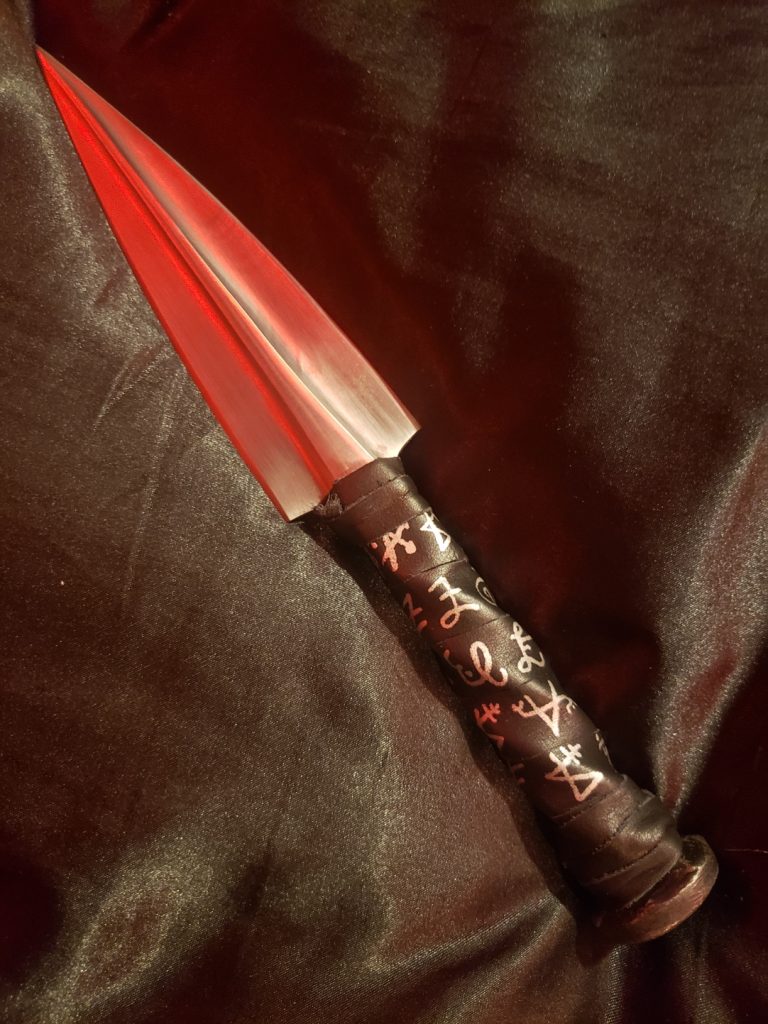
Another essential tool in many magical practices is the dagger. Like the wand, it is used for the focusing and projection of Will, but it is more incisive, appropriately more suited for acts of severing than for creation. It is a phallic symbol and is used as such in rituals of fertility. It is also frequently used for the delineation of sacred space, which is the primary use for my blade.
I have used a number of different knives in this capacity over the years of my practice, including one attempt to make my own which I never found satisfactory. I still use a few of those on certain occasions. This is one of my working tools that I did not make myself. It started out as a ‘Rallar Knife 10’ from Grimfrost in Sweden. It is hand-forged from a railroad spike, hence its name. I received it as a gift several years ago. It’s a beautiful piece of work.
I initially used it as it came but was looking for a way to make it mine. I inscribed the opening line of my ‘Claiming a Space’ banishing: By my Will, I cleave the dimensions in Toetic script on a strip of leather and used it as a handle wrap. Toetic is a script that I was introduced to in the DKMU. I use it frequently in the construction of my magical tools. It has a feel and flow that is conducive to a magical mindset. Now it fits in perfectly with the rest of my kit.
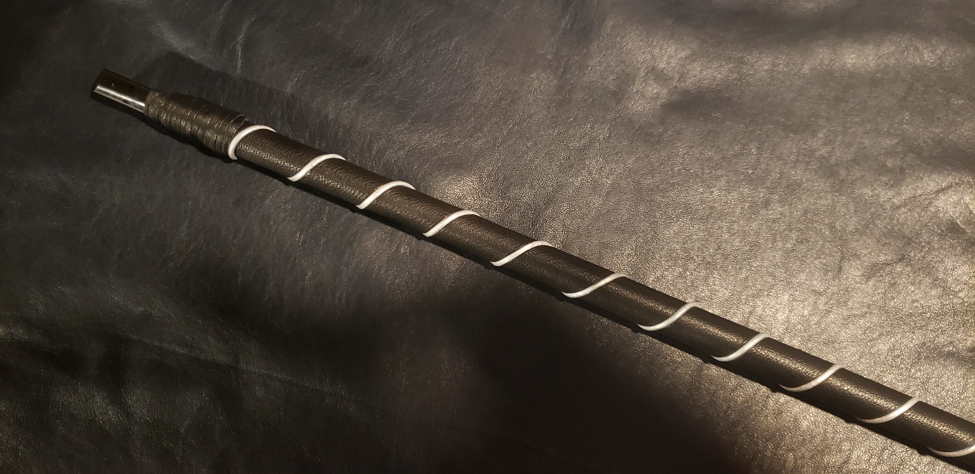
The wand is a ubiquitous magical tool. Much has been written about its use in ritual, so I’m not going to dive deeply into its origin and purpose, but Franz Bardon called it “the most important aid in ritual magic”. It is a conduit for focusing and conducting the will of the magician.
I built mine in 2021. I believe that the most effective tools are the ones that we craft ourselves. The act of designing and crafting encodes intent at every step, as well as creating a bond between the builder and the object. Which manifestation of the eternal Form the magician brings forth into the world says much about their approach to the work.
The core is a ½ inch birch rod. It is the length of my personal cubit. I chose birch due to its traditional association with creation. It is wrapped in black leather, with a silver leather cord spiraling down its length, hence the name. This is conducive to the flow of energy and intent. It is tipped with a black tourmaline point. Tourmaline exhibits the piezoelectric effect, so is a naturally energetic stone. It is also renowned magically for rectifying negative energies to positive.
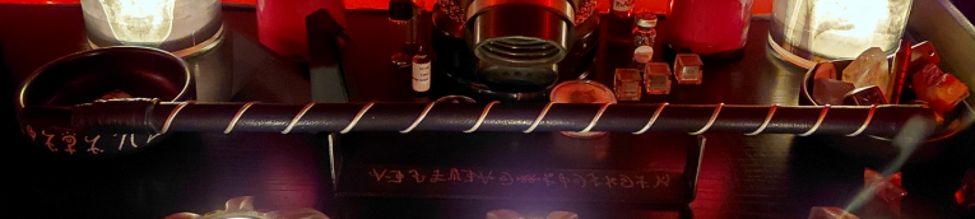
I also built a stand for it out of steel and leather, inscribed with symbols appropriate to its purpose:
The winding path from Forest Child to Cynical Sorcerer
I’m an Apostate from more faiths than most people likely practice throughout their entire lives. When I was a child, I was never forced to go to a Christian church. My parents were both raised in typical American families, my Mom being Southern Baptist, and my dad from an independent Church of Christ. I actually asked to attend a few services to see if I had an affinity for it. I didn’t. I read a lot of mythology and fantasy as a child, and I fervently believed in magic. By age 14 I was practicing my own form of animism. I left offerings in the woods for the nature spirits, and asked for their favor and assistance. I had been given a set of Runes, along with a photocopy of a guide book. I added divination and the creation of runic talismans and bindrunes to my budding practice. A year later, I acquired a 300 baud modem for my Tandy CoCo 2. I started using dial-up BBSes in my hometown. Through this medium, I discovered that there were a number of local pagans. I was thrilled to learn that I was not alone. Besides online correspondence, I eventually met several of these new friends in meatspace. At this time I was also just starting to be active in the SCA. Through this group, I met even more like-minded folk, including those that referred to themselves as Wiccans. I participated in my first formal group ritual at age 17. By age 18, I had read books by Ray Buckland, Scott Cunningham, Ed Fitch, Lois Bourne, and Laurie Cabot. I performed a self-initiation, and began to consider myself a Wiccan. I began to observe the standard sabbats and esbats.
As I entered college, I acquired my first mainframe accounts. These provided me with Bitnet and internet access. This allowed me to use IRC and Usenet. This access widened my horizons beyond my wildest expectations. I also discovered that the library at Indiana State had a surprisingly deep collection of occult books, including some rare volumes by Frater Achad and others. I began to spend every spare moment taking notes in the reference section, sometimes long into the night. In my Sophomore year in 1991, I met a former Wiccan who had converted to what he referred to as Odinism. I had grown up reading mythology and playing D&D, but I had never considered actually worshipping the Norse gods. My new friend gave me a copy of Rites of Odin by Ed Fitch. After reading it, I decided to leave my Wiccan practice and Profess Tyr as my patron. It helped bolster my decision when my own Wiccan mentor at the time also decided to convert.
Two years later, I graduated and moved to Indianapolis. My partner, who was a Wiccan when I met her (through the SCA), had also converted to what I now knew as Asatru. We networked within the local pagan community, and eventually found other Asatruar. We formed a Kindred, and then participated in the foundation of the Indiana Asatru Council. I became a Godman and Elder-in-Training in the Ring of Troth. At this time I also became an ordained minister through the ULC, since the Troth didn’t have ordination authority. Over the next five years I continued to practice Asatru, meeting many others from all across the United States via state and regional Althings. In 1998 things took a turn. I divorced my wife and quit the Kindred that we had helped found. I withdrew from my public-facing religious work. Although I still continued to work with the Runes, and with the later Icelandic sorcery that I had learned, I ceased to perform blots.
In 1999, something completely unexpected happened. I saw the film The Matrix. Soon after, I saw Stigmata. Through these films, I was introduced to some of the precepts of Gnosticism. I had first learned of the movement during my reference reading, but I really knew little of it. I had been growing increasingly disaffected with Asatru, and this faith grabbed me very quickly. I immersed myself in the Gnostic Gospels, while simultaneously going down the proverbial rabbit hole of Postmodern philosophy. Besides the historical materials, I was reading everything from Elaine Pagels to Jean Baudrillard to Philip K. Dick’s Exegesis. I tried very hard to find a spark of faith in everything that I was absorbing. But I didn’t. I couldn’t. I found the literature inspiring, and works like Thunder: Perfect Mind to be profound, but I couldn’t find the divine here. I was greatly disappointed in this outcome, but I was still happy with all of the new information that I had been exposed to. During that fin de siècle era, I came across a wide variety of philosophers, critics, and weirdos of every stripe.
It was now 2002. I stopped trying to force Gnosticism on myself and went a little meta. I arrived at the conclusion that the Gods, any Gods, just weren’t for me. I didn’t stop believing in them, I just realized that I had never been happy trying to worship them. So I stopped. But I still felt compelled to practice magic. That need seemed to be completely separate from my belief that a divine or spiritual power was putting their thumb on the scale of reality on my behalf. Faced with my lack of faith, but belief in magic, I decided that I would practice Chaos Magic. I had known some Chaotes online in college, and had met one in person, and had the idea that it was a non-theistic paradigm, but I knew nothing else. So I did what I do. I read everything by everyone I joined online Chaos forums, and started doing frequent magical workings. The more I experienced, the more this path seemed to fit me. In 2004, I joined the Dead Chaosist’s Society (eventually re-named the Tribe of the Fifth Aeon) forum on chaosmagic.com. This became my online home for the next several years. A lot of concepts that ended up being part of my practice (even to this day) and have been discussed in my books had their beginnings in discussions held on T5A. That same year, I attended my first large metaphysical event since I left Asatru, ‘Ancient Ways’ in Chicago. At that event I met a number of other Chaotes and attended their talks. It was at that event that I scrawled the page of notes that eventually became Quantum Sorcery.
Throughout my Chaos Magic practice over the years, online activity has still played an important role in several directions that I’ve gone. I don’t remember when I first encountered the DKMU via the deathbylollipops.com forum, but I do know that it was in 2011 that I performed my first LS tag operation and declared myself a Marauder. I’ve contributed a trove of material to the DKMU corpus over my years of working with the Egregores. Until recently, I spent a great deal of time on the DKMU Discord, but as many of my cohort have drifted off, so have I. Now I find myself interacting mainly through Substack.
I currently employ a syncretic paradigm that incorporates aspects of nearly every magical system that I’ve ever worked with. I style myself as a sorcerer. It’s not a grandiose title, but it suits me. I work mostly with my partner and occasionally with small groups of friends, either online or in-person. I think strange thoughts and inject them into the communal bitstream. If I’m fortunate, you read them. Good on you for that, by the way.
In the same unparalleled esoteric tradition as SpikeVision itself, we are elated to announce the emanation of a new psycho-magical construct for your utilization and edification. Hex-Prūf! The amazing new product by which one can render oneself utterly immune to all forms of hexes, curses, jinxes, and all other forms of malifica great and small. Whenever you suspect that you are the being targeted with ill intent, apply Hex-Prūf liberally. Re-apply frequently for best results.
Get yours today, wherever quality eldritch products are sold!
Successful magical work does not happen in a vacuum. There is almost always a mundane component that will be necessary to satisfy in order to create a causal pathway. For example, you are a pretty damned impressive magister if you can win a lottery jackpot without a ticket. You have to be capable of re-arranging objective reality on a gross scale for that to happen. You should write a book so that I can buy it and learn your techniques.
You’re still an amazing talent if you can win even with a ticket, but from a realistic standpoint that ticket is what turns an impossible outcome into an improbable one. Note that this case doesn’t specify that you didn’t personally buy a ticket, you may find a random ticket in a gutter that happens to be a winner, but you still need that token to open up that potential timeline in your Universe. It acts as the link between the entity that is you, and the series of events (pattern? protocol?) of a person winning the jackpot. The link is the key.
Links are concepts that are heavily used in both data space and in magical operations. In the software world, a linker is the tool that assembles discrete libraries and routines into a coherent executable whole. It makes connections between the definition of an object and all of the references that are made to it. In magical space, the link is one of the most important aspects of a working. The foundational Law of Contagion is based on this. It’s just that fundamental. A further expression, at the finest level of reality is quantum entanglement, the deepest link, between individual fundamental particles, and potentially even larger systems, as recent research has revealed, hence the suspicion that these phenomena are, ahem, connected.
As I mentioned in Phenomenal Sorcery, the physical artifact used to form the symbolic and semantic connection between a ritual component and the actual target is sometimes referred to as a taglock. The closer to the target this linking object is, the better the connection, and thus the more efficient and effective the magic done through its agency is likely to be. Something that was once a part of the target is best. Hair and nail clippings have been a key ingredient in sympathetic magic back to the beginning for this reason. Something that has touched the target is next best. It will carry an imprint of that which it has been in contact with. Lastly, a depiction of the target, be it a collage of magazine clippings, an effigy, or going back again to the origins of sorcery, a cave painting.
The taglock can be incorporated into a ritual or spell in any number of ways. It can be secreted into a poppet, candle, ice cube, or nearly any type of physical object. It can be subjected to positive or negative stimuli as desired. It can be lavished with loving attention. On the opposite end of the spectrum, it can be burned, pierced, buried, etc. The exact method of its use is up to the individual performing the work, and there are myriad examples to be found over a couple of millennia of recorded magical history to choose from.
The point that I want most to convey in all of this is that at its most basic form, magic can be performed with nothing more than Will, intent, a causal pathway and a taglock. Reduce the most complicated rituals down to their most basic form, and this is what you’re left with. Everything else is stage dressing to get the conscious mind out of the way of getting the work done. Props can help, indeed sometimes they can be the difference between success and failure, but they are not as essential as the four basic components. To be sure though, there are some practitioners who can do the work with Will and intent alone. They are few and far between and are not to be crossed.
Like Neo, or Siddhartha Gautama, I am just a man. I’m not an eldritch creature of extra-dimensional or supernatural origin. I’m made of meat and electricity; nothing more. Yet I can do magic. It turns out that anyone who can figure out the basic mechanics of how to alter reality through various non-local means is capable of doing so. The practice of magic requires several components. Belief, desire, a touch of madness, and an occasional disregard for personal safety are certainly among them. A code of ethics is also certainly to be desired but is patently absent from many who practice.
One definition of magic is the discipline of influence and prediction. This is facilitated by connecting to the Universe at a fundamental level, so that its ebb and flow can be not just perceived but nudged this way and that to reach an end state where that which is desired is manifest. This connection can be created by any number of means. There is a vast corpus of esoteric material spanning millennia and civilizations to choose from, or one can eschew all prior modalities and create their own system which is utterly novel. The particular path may present itself, or even a number of them over time.
Whether used for beneficial or baneful purposes, practicing magic comes with a cost. Changing the world changes you. At best, it permanently alters your perceptions and perspective. At worst, it can lead to obsession and other mental crises. So do it with thought and clear intent. Magical experimentation is of paramount importance, but consistently working without a specifically envisioned end state is of little value. Don’t shit on another mage’s paradigm if it works for them. Even if you think their techniques are absurd, give them the grace to do their work their way. Understand that magical systems are just toolsets for achieving one’s ends. Whether via meticulously inscribed leaden tablets for calling on celestial entities, blending herbs and powders, or masturbating to sigils, in magic the ends justify the means.
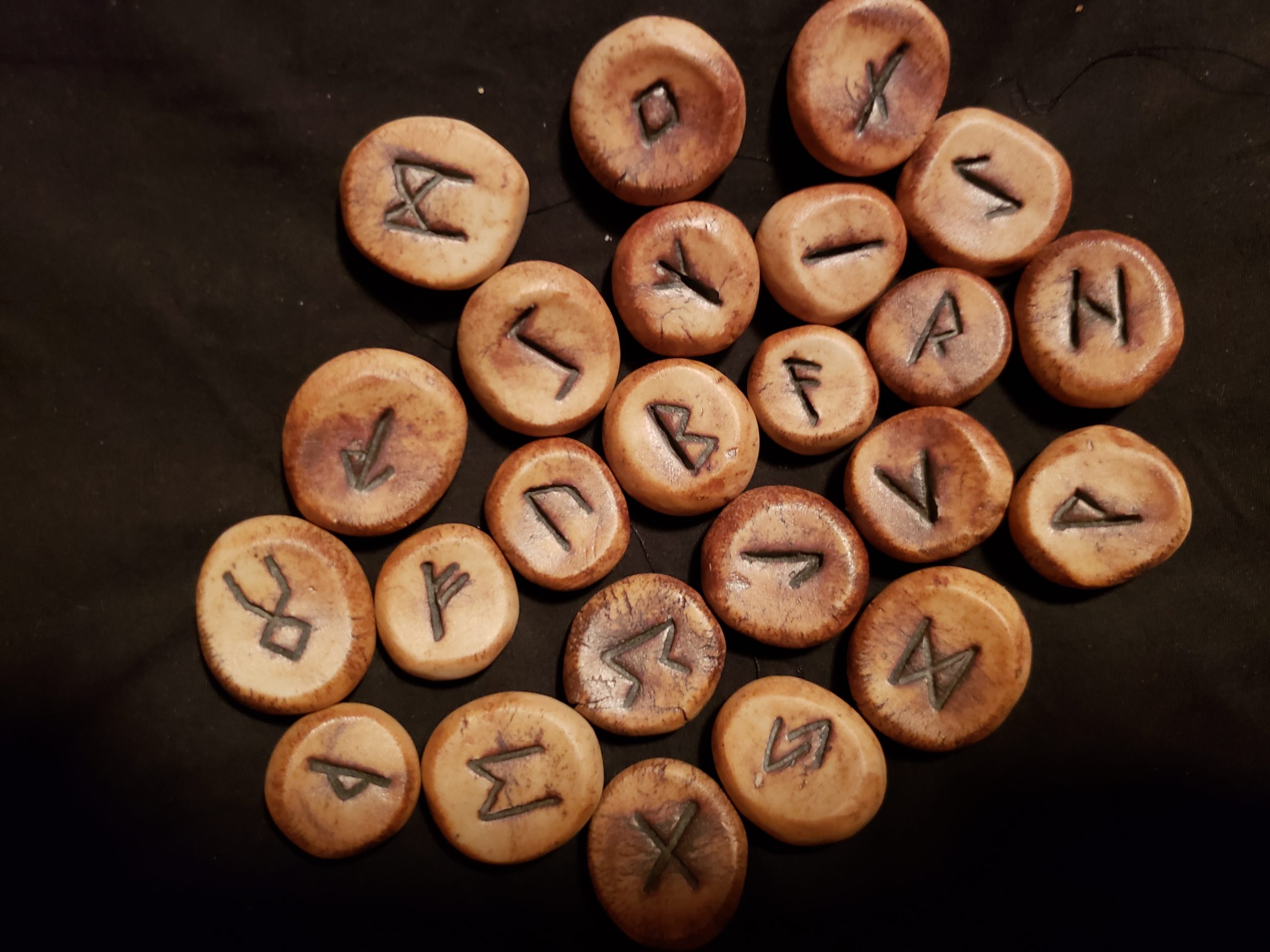
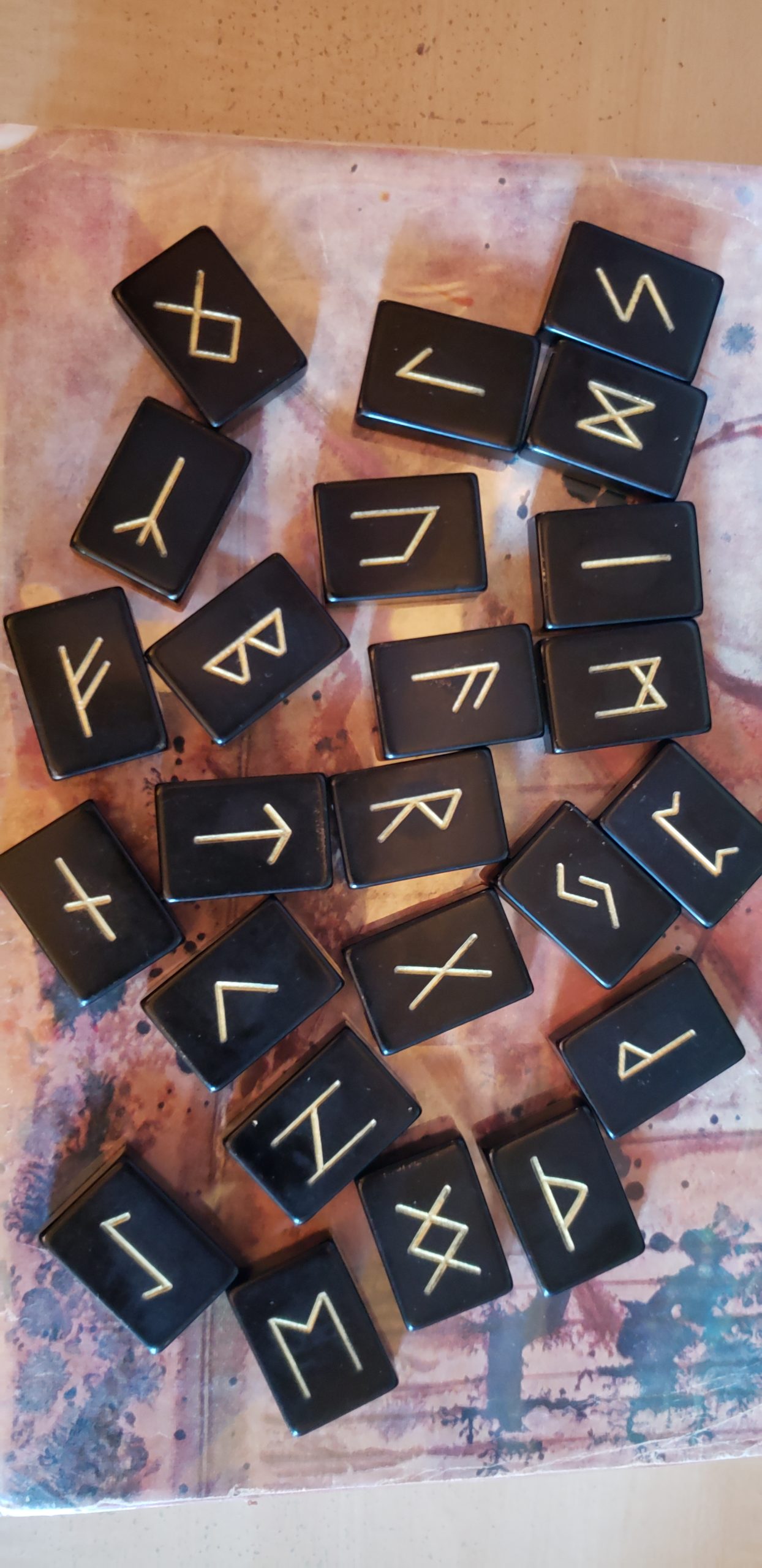
I have been using the Elder Futhark runes for divination since 1985. I was given a copy of Ralph Blum’s The Book of Runes by a classmate. Although most authors ascribe different meanings to the runes than Blum did, I still found them to be quite useful. It wasn’t until I began to practice Asatru some eight years later that I read works by Thorsson, Tyson, Gundarsson, Cooper, Paxson and others that I learned potentially more traditional meanings. Here are the various sets that I currently have.
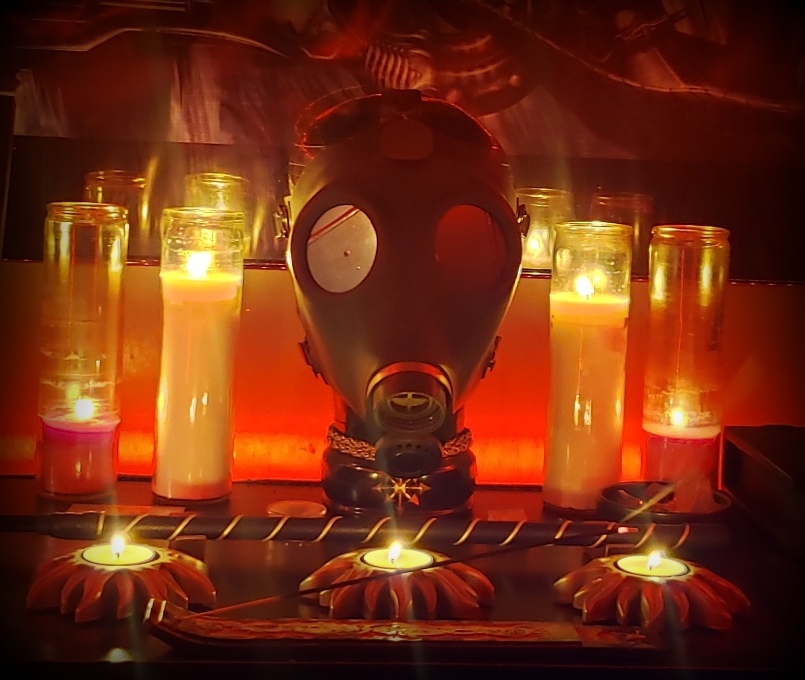
One of my constructs is the Altar Ego. This is a glass sculpture of a human head that serves as the central focus of my altar. It has been covered in PVC tape and is wearing a gas mask. It wears a stainless steel box chain necklace that was made for me by a friend many years ago. On this chain is an emblem of chaos pendant. Upon the brow of this mask is an Ægishjalmr medallion. The figure looks alien by design. It is sleek, inscrutable, and somewhat sinister in appearance.
I begin each session of magical work by syncing myself with this construct. It is an agent or servitor which facilitates the expression of my intent. I envision this as analogous to a compiler which converts my magical source code into executable code for the Universe to run. In addition to this primary function, it also serves as my magical alter-ego for certain workings of sympathetic magic.